FIREARMS
GLOSSARY
(March 2024)
Both agents and insurers should strive
to properly protect their customers’ possessions which have special value and
significance. Personal property that an insured collects as a hobby or for
investment purposes has both of these qualities. Special attention is needed
because collectibles, such as guns, only have limited coverage under a
homeowners policy. Since coverage is so paltry, requests to schedule guns and
related property are common. Any insight into a special type of property is
always a good thing. It is in this spirit that we offer a glossary of firearm
terms. It has been prepared after researching various sources and compiled by
our editing staff.
|
|
- A -
ACP–Abbreviation for automatic colt
pistol.
accidental discharge–An
unexpected, unwanted firearm discharge caused by firearm parts breakage or
mechanical failure.
action–A firearm’s working mechanism
(typically the receiver or frame and breech bolt) that facilitates its firing
and loading/unloading. There are a variety of types of actions from single to
automatic.
action shooting–A
competitive event where participants draw holstered pistols and fire at
various-shaped, small targets. The winner is the most accurate shooter or
fastest shooter.
adjustable trigger–Triggers,
usually found on custom firearms, used in target-shooting where the trigger
spacing can be changed.
AE–See automatic ejectors.
air gun–Refers to any gun that fires
projectiles (BBs, pellets) by C02 or compressed air.
ambidextrous safety–A
manual safety that a shooter can reach and operate easily with either hand.
ammo–Abbreviated
form of ammunition.
ammunition–A
complete assembly consisting of a case, a charge (gunpowder) and a projectile.
Also known as fixed ammunition.
ANIB–See as new
in original box.
antique–Refers to
any firearm, manufactured pre-1899, that is not designed to fire fixed
ammunition or for which ammunition is unavailable.
aperture sight–A
rear sight found on rifles and shotguns consisting of a thick rim and a small
opening at the weapon’s rear paired with a front-located blade sight.
AR-15–A very
popular semi-automatic rifle original made by Armalite Manufacturing.
armor-piercing
ammunition–The U.S. Government defines it as projectiles that are used in
handguns and which consist (entirely or primarily) of beryllium copper, brass,
bronze, depleted uranium, iron, steel, or tungsten alloys.
arsenal–A government
facility that makes, repairs and stores ammunition and firearms.
articulated front
trigger–A hinged trigger that is designed to minimize the force of the
gun’s recoil on the trigger finger.
artillery–Typically
refers to firearms with bore diameters of 3 or more inches. Generally, they
fire explosive projectiles and must be operated by a crew.
as new in original
box–A term for guns that are virtually unused and maintained in mint condition.
assault rifle–A
selective-fire rifle designed to rapidly fire intermediate power cartridges.
This type of firearm originated in early 1940s Germany. Their “storm rifle” was
made to spray bullets to maximize the weapon’s ability to wound and kill during
combat.
assault weapon–Technically
any weapon used in an assault, but usually refers to firearms that are
compatible for efficient attacks. See weapon.
auto(matic) loading–See
semi-automatic.
automatic ejectors–Guns
with a breech feature that pops out fired shells or positions unfired shells so
that may be manually pulled out.
automatic firearm–Firearm
that continuously feeds cartridges, fires their bullets, and ejects their empty
cases.
automatic pistol–Popular term that is a misnomer. See
semi-automatic pistol.
automatic safety–A feature on a break-open gun that resets the gun
safety each time such guns are opened.
- B -
back boring–Reaming
the rear internal diameter of a shotgun barrel beyond its standard gauge. While
this practice increases the shot pattern accuracy and reduces recoil, it also
reduces the barrel’s integrity (safety).
backstop–The part
of a target that keeps projectiles from passing through.
backstrap–The
part of a pistol that is exposed at the rear of the grip.
baker ejectors–See
automatic ejectors.
ball–Typically
refers to a cylinder-shaped bullet with either a rounded or pointed nose and is
usually used with muzzle-loaded firearms.
ballistics–The study
of projectile motion and effects.
ballistic
fingerprint–A
record (usually kept in a database) of the markings left on a projectile when
it is fired.
barrel–The
rifled or smooth tube that a projectile travels after it’s been fired.
barrel band–A
fixed or adjustable band that holds a gun’s barrel and stock together.
barrel band front sight–A gun sight located on the front of a
barrel, consisting of a band that completely surrounds the barrel.
barrel
liner–A liner made of special material that is inserted into a
bore to either protect the bore, correct bore erosion or to alter the bore so that
it can fire smaller caliber ammo.
barrel locks–Devices
inserted into a firearm’s barrel or through the barrel and chamber to prevent
discharge.
barrel selector–Component
that determines the firing order in a double barrel gun.
base wad–A paper filling that is found in the shotgun shell’s
powder charge.
BATFE–Abbreviation for Bureau of Alcohol, Tobacco, Firearms and
Explosives. It’s a division of the Dept. of Homeland Security that enforces
laws related to property specified in its name.
battery–The flintlock component that, when struck, creates sparks
that ignites the powder.
bayonet–An edged weapon mounted
on the muzzle end of a firearm
and used as a backup weapon. The first bayonets were basically daggers
stuck in the muzzle of a musket, so that it could be used as a pike in close
combat.
bayonet lug–A mounting on a firearm for attaching a bayonet or
accessory.
BBL–Abbreviation for barrel.
beaded cheek piece–A raised area of decorative beads located in the place
where a cheek is rested while firing a gun.
bedding–The point to which a firearm’s barrel is fitted.
beavertail–A large, curved piece of metal located at the top of a gun
grip that prevents being pinched by a gun’s hammer.
beavertail forend–A wide-styled forend.
bench–A notch located in either a gun’s hammer or in a firing
pin housing. The sear rests temporarily in this area after cocking.
benchrest (shooting)–A
competition where participants fire from a fixed shooting position in an
attempt to place consecutive shots into the smallest possible grouping on a
paper target. Typically, it involves groups of at least 10 shots and at
different target distances.
berdan primer–See primer.
bipod–A two-legged support that is mounted to a rifle’s front end
to stabilize for aiming and shooting.
bird shot–Refers to shotgun projectiles that have a diameter less
than .24".
black powder–The
earliest form of firearm propellant. Except for its use in antique guns, it has
been replaced by higher pressure, smokeless powder.
blank cartridge–A
cartridge containing a charge but NO projectile. It is used for starter’s guns
or for special uses such as in movies or theatre productions.
blind box magazine–A magazine that is
inserted into a firearm handle and has a permanent closed bottom.
bluing–A gun’s
blue or black metal finish that is the result of an acid bath.
boattail–A bullet with a tapered end that
improves its long-range efficiency due to reduced drag.
body armor–Vest
type jacket worn by law enforcement or military personnel. It is usually made
of light-weight, bullet resistive material such as Kevlar.
bolt-action–A firearm with an assembly that
requires a user to manually lock a cartridge into firing position in its barrel
or chamber.
bore–The interior
of a firearm's barrel excluding the chamber.
box magazine–An
ammunition holder where the cartridges are vertically stacked.
brass–A slang
term for a spent case. It’s used because a case is most commonly made out of
brass.
break–See trigger
break.
breech–The rear
part of a gun’s bore.
breechblock–A
movable piece of metal used to open and close a gun’s breech.
BT–See beavertail forend.
buck shot–Refers to shotgun projectiles that have a diameter
of .24 or greater.
buckhorn sight–An
open, metallic rear sight with sides that curl similarly to a buck’s horns.
bug–Shortened
reference for back up gun.
bull barrel–A heavier,
thicker than normal barrel with little or no taper.
bullet–The
projectile expelled from a gun which is distinct from a cartridge. Bullets come
in a variety of types and are usually composed of lead or lead that is shielded
with a harder metal.
bullet-proof jacket
or vest–A misnomer. See body armor.
bushed
firing pins–A circular steel fitting that screws into a gun’s breech
and houses a firing pin. It facilitates easier replacement of broken firing
pins and better breech maintenance.
butt–Describes
the bottom part of a pistol grip and the rear or shoulder portion of a rifle or
shotgun.
butt
plate–A covering that protects the butt of a firearm. The cover
may be metal, plastic, rubber, or some other material.
- C -
caliber–The diameter of a projectile for a
rifled firearm or the interior diameter of a rifled barrel. In the U.S., the
diameter is expressed in hundreds of an inch.
calibre–See caliber.
can–A slang
reference for any form of sound suppressor.
cannelure–A groove around a projectile’s
circumference.
carbine–This name
applies to any short-barreled rifle (designed for easier use and concealment).
cartridge–A single,
complete round of ammunition consisting of a case, charge (propellant) and
projectile (bullet).
cartouche–On a
gun, a stamped area on a gun stock that has the initials of the person who
inspected and accepted a gun into service (an inspection date is usually included).
case, casing–The
material that surrounds and holds the charge (cartridge propellant) and/or
projectile. It is typically made of brass.
caseless
ammunition–Ammo that includes a propellant charge in its base rather
than in a separate case.
CCW–Refers either
to “Carry Concealed” or “Concealed Carry” Weapon. The former is the act of
having a concealed weapon on one’s person, the latter is ownership of a permit
to do so.
center-fire–A cartridge with a primer placed at the
center of its casing’s base.
chamber–The area
of a firearm that holds a cartridge immediately prior to its being fired.
chamfer–See
crowning.
charcoal color
casehardening–A method of strengthening gun metal by subjecting it to high
heat and plunging it into cold water.
charging
handle–A handle that cycles a semi or fully automatic firearm
without discharging.
checkering–The
diamond-shaped tool patterns that are cut into firearm grips.
cheek
piece–A raised portion on the side of the gun’s stock where a user
rests his or her cheek while operating a gun.
choke–A
constriction at or near a shotgun muzzle. It is designed to control shot
dispersion.
claw extractor–A
feature found on bolt-action guns. A claw component that holds and then pulls
cartridges out of a magazine.
clearing–Unloading and verifying that a gun does NOT contain
ammunition.
clip–Popularly
refers to a container that holds a group of cartridges, which may either be
transferred or inserted into a firearm.
closed bolt firing system–A firearm with an enclosed action where
upon firing, another cartridge is chambered and ready for the next shot.
CN–Abbreviation of “Chloracetohenone,” the
full chemical name for tear gas.
cock–The
hammer-like device on early firearms that set the weapon into
"firing" position.
cocking (a gun)–Pulling
back a gun’s hammer into its firing position.
cocking
handle–See charging handle.
cocking indicators–Any
device that is designed to display whether each barrel has been cocked and/or
fired. Typically located on a hammer.
cold range–Requiring
a gun to be kept unloaded on a pistol range until it is time to fire at a
target on a pistol range.
comb–The portion
of the stock where a shooter rests his or her cheek.
combat shooting–A competition using handguns that
simulates situations found in personal protection situations.
combination gun–Typically
refers to a shotgun-style base, supporting both a rifle and a shotgun barrel
and capable of using several different calibers of ammo.
COM–Center of
(bodily) Mass, most effective area to target when firing.
compensator–See
muzzle brake.
cop-killer bullet–An
inflammatory phrase typically used to refer to ammunition capable of piercing body
armor (bullet-proof jackets).
cover garment–Any
article of clothing that conceals a gun and holster, such as a sweater or
jacket.
crane–A U-shaped
yoke that supports and facilitates the operation of a cylinder.
cross-dominant–A right-handed shooter who aims with
his left eye and vice versa.
crosshairs–The
sighting lines in a telescopic sight.
crown–The
finished contour of a muzzle or a rifle.
crowning–The
process of rounding and countersinking a barrel muzzle.
cupro-nickel–A silver-colored alloy
of copper and nickel used to make bullet jackets.
cylinder–A
drum-shaped component of a revolver that houses its ammunition.
- D -
DA–See double action.
damascene–Decorating
one metal by inlaying or attaching another metal.
damascus barrel–A
barrel made by welding thin strips of metal that have been twisted around a
metal rod (called a mandrel).
dampeners–An
accessory, usually added to a rifle’s stock, to absorb the shock of recoil.
decimate–Literally
“reducing by a tenth.” Any strategy designed to reduce an attacking force (or
number of targets) by, at least, a tenth.
decocker–A lever
found on double-action, semi-automatic firearms which lowers their hammers
without firing.
demi-bloc barrels–A
method of joining two barrels in which the lumps are integrated into each
barrel. This joining method facilitates stronger barrels and greater accuracy
in aiming.
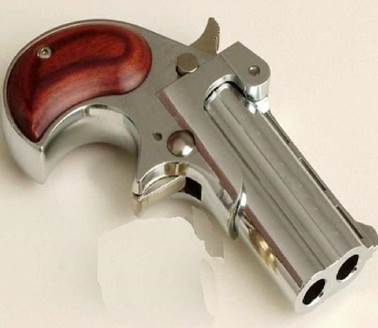
derringer–A very
short-barreled (one or two shot) pocket pistol named after its inventor, Henry
Derringer.
deterrent–A material
used with gun powder to slow its burn rate.
detonate–To
ignite (initiate) an explosive device.
discharge–To fire
a weapon.
dispersion–Travel pattern of bullets fired from a single source.
double-action –A firearm that is fired either by manually cocking the
weapon and then pulling the trigger or by using trigger action to both cock and
fire the weapon.
double action only–Guns that are fired by
using the trigger to first cock the hammer and then
fire the piece for each shot. Between shots, the hammer rests forward,
uncocked.
double-barreled shotgun–A
shot gun with two separate barrels, allowing for two discharges before
reloading.
double-feed–Occurs when a fresh round is blocked from a
firearm’s chamber by a case that was not properly ejected.
double-set trigger
–A device consisting of one trigger which cocks and gun while the partner fires
it.
double-tap–A succession of two shots fired rapidly from
a semiautomatic pistol, rifle or shotgun, or a revolver.
dove-tailed
barrels–A method for side-by-side
barrels where two barrels are filed at their breech end and fitted into a
solid, metal block.
drilling–A German
term, referring to a gun with three-barrels.
drop safety–A
form of safety that prevents a gun from firing when it is dropped.
drum magazine–Refers
to an ammunition holder where cartridges are stored in a circular fashion.
dry firing–Discharging
an unloaded firearm in order to become familiar with its operation.
dud–A popular term for a cartridge that fails to fire after
its primer is struck by the firearm's firing pin. See hangfire.
dum-dum bullet–A
lead-core, shielded bullet with an open nose that was developed by the British
in the late 19th Century. It was outlawed by the 1899 Hague
Convention.
dummy bullet–A cartridge
with a bullet, but NO propellant or operating primer. Used for demonstrating firearm
loading procedures.
- E -
EARS–Slang for any form of firearm hearing
protection.
EHP–See electronic hearing protection.
ejector–A
mechanism that throws cases free of a firearm.
ejection
port–An opening in a firearm that permits the emptying of spent
ammunition.
ejection rod–The metal dowel that allows
fired bullet cases to be pushed out of a revolver chamber.
elevation–A long-range sighting component
that allow for adjustments to compensate for the effects on projectiles caused
by changes in elevation above sea-level.
electronic hearing
protection–Earmuffs with electronics that amplify voices while shutting out
other noises that exceed a given decibel.
English stock–A
straight rifle stock with a slender grip.
escutcheon–A
decorated metal plate that is fitted (inlaid) into a gunstock. It is usually
engraved with the original owner’s monogram or a coat of arms.
excellent–(NRA Condition
Standard) all original parts; over
80% original finish; sharp lettering, numeral and design on metal and wood;
unmarred wood; fine bore.
expanding bullet–Any
bullet that is designed to expand upon striking. This action increases the
bullet’s stopping power (and lethality).
expert marksman–A
highly-skilled shooter, capable of hitting any target falling within weapon
range.
exploding bullet–A
bullet with an explosive component that explodes under striking (ironically
this feature severely reduces its ability to penetrate a target).
extractor–A
device that pulls (hooks) spent cases out of a chamber.
extrinsic safety–An
external component that is attached to a gun to avoid unintended discharge, such
as a separate trigger lock.
- F -
factory new–(NRA
Condition Standard) all original
parts: 100% original finish: in perfect condition in every respect, inside and
out.
failure to extract (FTE)–See
double-feed.
fair–(NRA
Condition Standard) some major parts replaced; minor replacement parts may be
required; metal rusted, may be lightly pitted all over, vigorously cleaned, or
re-blued; rounded edges of metal and wood; principal lettering, numerals, and
design on metal partly obliterated; wood scratched, bruised, cracked, or
repaired where broken; in fair working order or can be easily repaired and
placed in working order.
federal
firearm dealer’s license–A person who buys and sells guns must
hold a valid license to do so. Such license copies must be held by the
recipient dealer when receiving a gun shipment.
feed–To
move a live cartridge from a firearm’s magazine to its chamber.
feed
ramp–An inclined part connected to a firing chamber that assists
in moving ammo into the firing position.
FFL–See
federal firearm dealer’s license.
field gun–A
lighter weight shot gun used in hunting and which is carried for long
distances.
figured walnut–Subjective
grading of quality of walnut wood grain used in gun stocks.
fine–(NRA
Condition Standard) all original
parts: over 30% original finish: sharp lettering and numerals on metal and wood,
minor marring on wood, good bore.
firearm–Technically,
any pistol, rifle, or shotgun that uses gunpowder to launch projectiles.
firepower–A generic reference to how heavily or seriously
armed a party is.
firing
pin–The breech component that strikes the primer, igniting the
cartridge.
fit and finish–Refers
to a firearm’s over-all workmanship.
fixed ammunition–See
ammunition.
flash–The light
emitted from a weapon’s muzzle when it is discharged.
flash hider/flash
suppressor–An accessory that is attached to a muzzle. It is designed to
minimize any visible muzzle flash during discharge.
flat point/nose–A
bullet with a flat rather than rounded point.
flintlock–An
antique gun which has a firing mechanism consisting of flint striking steel to
create sparks that ignites a primer.
floating barrel–
A barrel bedded to avoid contact with a gun’s stock.
floor
plate–The bottom plate of a cartridge magazine that’s removable.
FMJ–See full
metal jacket.
forcing
cone–The tapered front section of a revolver or shotgun chamber
that reduces in size to match the barrel’s bore (diameter).
forearm–The portion of
a stock located under a firearm’s barrel.
fore end–See forend.
forend–The front
portion of a rifle or shotgun stock.
F.M.J.–See full metal
jacket.
F.P.S.–Feet per second of
speed of a projectile’s speed.
frame–See receiver.
frangible bullet–A projectile
designed to minimize ricochets by disintegrating when a hard surface is struck.
free rifle–A
rifle, having to weigh less than 17.6 pounds, which is designed for international-type
target shooting.
frizzen–The part of a flintlock which is struck by a piece
of flint, producing a shower of sparks.
front strap–The forward-facing
portion of a pistol or revolver that is joined with the trigger guard.
full metal jacket–A bullet that is fully encased with a layer of metal
(usually copper), which maximizes its ability to penetrate a target.
fully automatic
firearm–See automatic firearm.
- G -
gain twist–A barrel with an increasing pitch in its rifle grooves,
resulting in an accelerated bullet spin.
garand–Common name given to
the U.S. Rifle, Caliber .30, M1.
gas-operated–An automatic or semi-automatic firearm
that uses propellant gases to operate its case ejections.
gauge–Refers to a
shotgun barrel’s bore size.
GCA 68–See Gun
Control Act of 1968.
Geneva Convention(s)–A
set of international agreements regarding the behavior of warring nations. It
is frequently noted for its ban on the use of ammunition designed to expand
upon impact.
ghost ring sight–A
sight with a large opening and a thin rim that is positioned on the rear of a
rifle or a shotgun. It is used in conjunction with a front-mounted sight and
results in the ability to quickly find a target.
glassbedding–Epoxy
used to compensate for a poor fit between a gun’s metal and wood components.
good–(NRA
Condition Standard) some minor
replacement parts; metal smoothly rusted or slightly pitted in places, cleaned
or re-blued (metal re-colored); principal lettering, numerals, and design on
metal legible; wood refinished. Scratched, bruised, or minor cracks repaired,
in good working order.
grip
safety–A locking device located on the grip which, unless
depressed, prevents a discharge.
grooves–See
rifling.
gun–In the U.S.,
term may be applied to air guns, cannons, pistols, rifles, and shotguns.
gun control–Typically
refers to either existing or proposed laws involving firearm sales and
ownership.
Gun Control Act of
1968–The main piece of federal legislation that controls the major aspects
of gun ownership and distribution in the United States.
gun free zone–Any
area where citizens are prohibited from possessing a firearm.
gun lobby–A term
typically (and some might argue, pejoratively) applied to any persons or
organizations who work to influence pro-gun ownership laws.
gun lock–The firearm
mechanism responsible for exploding the primer (charge).
gunnery–The
art/practice of building and operating large bore guns.
gun nut–A
pejorative label for a gun enthusiast.
gun powder–Any
powdered substance that can be ignited and is suited for propelling
projectiles.
gun safe–See lock
box.
gun smith–A
person skilled in making and repairing guns.
- H -
hammer–The firearm
component that causes the firing pin to ignite a cartridge primer.
hammer
block–A safety device that separates the hammer from the firing
pin until discharged.
hammerless–A
firearm with a frame design that conceals its firing pin and hammer.
hand–The part of a revolver which turns the cylinder as the gun is cocked.
handgun–See
pistol.
hangfire–A cartridge that has a delayed discharge due either to
defective primer or a defective blow from a firing pin.
hardball–Slang for a bullet with a full, metal
jacket.
head–See
base.
heavy trigger–A trigger that must be pulled hard to
reach the firearm’s trigger break (firing) position.
heel–The
base of a bullet or firearm stock.
high-capacity
magazine–An informal reference to a magazine holding a high number of
cartridges.
high intensity–Projectiles
that fire at a very high velocity, resulting in longer range shots.
high kneeling–A
shooting stance where person is on both knees, holding upper body erect.
hinged
frame action–A firearm design where the action may be opened to pivot
down, sideways, or up to allow for loading and unloading.
hollow-point bullet–A
bullet with a concave nose that maximizes its ability to expand after it
penetrates a target.
hoplophobe–A
coined term for persons with an irrational fear of weapons. Apparently
pejorative, it comes from the Greek words for tool or weapon and fear.
howitzer–An artillery piece
which is used to fire projectiles over medium ranges on high trajectories.
HMR–Hornady Magnum Rimfire brand ammunition.
HP–Abbreviation
for a hollow point bullet.
- I -
igniting charge–See
primer.
improved cylinder choke–A
minimal amount of barrel constriction that permits a wide shot pattern.
incendiary ammunition–Ammunition featuring projectiles
with a base that ignites upon contact with objects with the intent to start
fires.
inertial firing pin–A
model of firing pin that is only long enough to make contact with cartridge
primer when forced forward by a hammer.
integral
lock–An internal lock
that prevents firing a firearm.
intermediate cartridge–A cartridge designed to
allow controllable automatic
fire from a rifle.
internal safety–A gun safety that may not be accessed by a firearm user and
is designed to minimize unintended discharges.
international
ballistics–See ballistics.
International Practical Shooting
Confederation–The governing organization that
oversees global action and combat shooting competitions. Headquarters: Sedro
Woolley, WA.
intrinsic safety
device–Any permanently installed firearm
component that is designed to minimize the chance of an unintended discharge.
IPSC–See International
Practical Shooting Confederation.
iron
sights–A non-telescopic firearm sight.
isosceles
stance–A shooting stance in which a gun is held in both hands and
arms are held out straight from the body.
- J -
jacket–A layer of
material, metal or synthetic, which encloses the (typically lead) core of a
bullet.
jacketed hollow point
bullet–A bullet enclosed by a copper alloy but with a cavity in the bullet
core which expands upon impact.
jacketed soft point
bullet–A bullet enclosed by a copper alloy, with the exception of the
bullet’s nose. The softer bullet point expands upon impact.
JHP–Abbreviation
for jacketed hollow point bullet.
JSP–Abbreviation
for a jacketed soft point bullet.
jump–Refers to the
change in bore diameter as a bullet travels from a chamber to the muzzle.
- K -
Kentucky rifle–A type of flintlock firearm, characterized by a short stock
and a long barrel.
Kevlar–A
light weight, bullet resistive material.
Kevlar
vest–See body armor.
keyhole–The
elongated hole caused when an unstable projectile strikes a target sideways.
kick–See
recoil.
- L -
laminated
stock–A warp-resistant stock that is made layers of wood that
have been glued together under pressure.
land
and groove impression–The rifling marks left on a discharged
bullet.
lands–See
rifling.
leading–Remnants
in a firearm bore that is left by fired bullets.
lethality–A weapon’s
or ammunition’s subjective level of producing a fatal result.
lever-action–A
gun mechanism that is operated (loaded, fired, unloaded) by a lever, typically
located below the receiver.
loaded–A firearm with
a cartridge in its firing chamber.
loading
gate–A hinged or spring-loaded cover that, when opened, allows a
firearm to be loaded.
loading
port–A receiver opening that facilitates a cartridge.
lock–Typically
refers to securing the bolt of a firearm before firing it.
lock box–A heavy,
metal storage box with either a key or combination lock that is used for a
pistol, ammunition, and accessories storage.
lock time–The amount of time between when the trigger
is pulled and the gun goes off.
locking lugs–Firearm
bolt projections that fit into a receiver so that, when the bolt is closed, the
action is locked into firing position.
L.R.–Abbreviation for long rifle.
- M -
machine gun–A
rifled firearm capable of automatically feeding, firing, and ejecting
high-powered cartridges. Typically, only military ownership and use is
permitted.
machine pistol–See
submachine gun.
magazine–Refers to either a permanent or detachable,
spring-loaded container for cartridges. It is often considered the same as a
clip. One distinction is that, externally, a magazine appears to complete the
firearm’s form, while a clip is an ammunition insert (or transfer device) that
does not affect external appearance.
magazine
disconnector–See
magazine safety.
magazine
floorplate–The bottom of a
fixed magazine.
magazine
follower–A spring-actuated
device to push cartridges in a magazine to the feeding position.
magazine
release–A device that
retains or releases a detachable magazine in a firearm.
magazine
safety–A device that
prevents a pistol from firing without a magazine being fully inserted.
magazine
well–The opening in a firearm that receives
the detachable magazine.
magnum–Refers to a gun designed to fire heavy-load metal
cartridges or shells.
mainspring–A strong spring, a.k.a. an energy
storage device that operates the striker or hammer of a firearm.
Mannlicher stock–A
slender forend that extends to the muzzle.
match–A treated cord (cotton or hemp) used
for ignition in matchlock firearms.
matchlock–An
early firearm with a firing mechanism that held a smoldering, treated cord (match)
which would burn until it reached a barrel opening (touch hole), explode the
powder, discharging a bullet.
metallic sight–A
firearm sight to aid a user’s aim but is not telescopic.
micrometer sight–A sight that is finely adjustable.
military firearm–An
informal term, generally implying a pistol with accessories that is suited for
military rather than civilian use.
militia–Technically
refers to any group of armed citizenry.
misfire–When cartridge
fails to fire due to it or a firearm being defective.
Mississippi rifle–Slang term for the U.S.
Rifle M1841. The name comes from their use by a group of U.S. Volunteers from
Mississippi who were commanded by Jefferson Davis in the Mexican War.
monte carlo stock–A
stock with an elevated comb that is typically used with rifles equipped with
telescopic sights.
mortar–An artillery piece used
to fire shells over short ranges at very high trajectories.
Mouse gun–Derogatory term
for any small caliber (low powered) gun.
mouth–A cartridge’s
open end that accepts a bullet.
multi-barreled–A gun with more than one barrel (ex. double-barreled
shotgun or derringer).
mushroomed bullet–Describes
a bullet’s nose which has expanded after striking a target.
musket–A long-barreled,
flared end firearm with a smooth bore. It was a single-shot weapon, loaded
through its muzzle.
musketoon–A musket
with a modified barrel for use by soldiers on horseback.
muzzle–A barrel’s open end that is a projectile’s exit.
muzzle brake–A muzzle with an accessory or a modification that
acts to control gas expansion which, in turn, reduces the amount of gun recoil.
muzzleloader–The earliest forerunner of modern firearms. Such
guns require powder and projectiles to be separately loaded through either the
muzzle or, with revolvers, through cylinder chambers.
- N -
National Firearms Act
of 1934–Federal act that regulates firearm
ownership and sales and registration of certain classes of firearms
National Rifle
Association–This organization is an advocate
of the public’s right to own guns, provides training related to safe gun use,
and sponsors firearm competitions on a national basis.
needle gun–An early
rifle that was first fired using a bolt action.
negligent discharge–A term that is used to refer to unintended
discharge of a firearm that causes bodily injury, property damage, etc. Gun advocates
and proponents debate whether it should be synonymous with accidental
discharge.
night sights–Iron
sights that emit light in the dark to facilitate shooting low-light conditions.
nipple–The area of a
firearm where flame accesses and ignites a cartridge’s powder charge.
nose–The forward point
of a bullet.
NRA–See National Rifle Association.
- O -
obturation–The
expansion of a cartridge case as it travels through a barrel or muzzle. The
expansion seals gases and helps propel the bullet.
off-hand–Either firing
a firearm without benefit of bracing or while using a non-dominant hand.
ogive–The curved nose
of a missile, rocket or projectile.
open sight–A commonly used
sight that is located at the rear of pistols rifles and shotguns and has an
open notch at its top.
operating
handle–See charging handle.
optical
sight–Generic reference for laser and telescopic sights.
out
of battery–Describes a breeching mechanism that is properly aligned
for firing.
overshoot–Launching
a projectile beyond a designated target site.
over travel–Refers
to a trigger that continues backward movement after a shot is fired.
over-under–A two-barrel gun in which the barrels are
vertically stacked.
- P -
+P/+P+–A
method of increasing cartridge velocity by loading it to higher pressure than
is normally used for its caliber.
pan–A
small side-mounted container found in early firearms which held priming powder.
parkerizing–A
gray or green, rust-resistant matted finish used on military guns.
partition
bullet–A two-chambered, jacketed bullet. The front portion expands
on impact and the rear piece remains intact to ensure penetration.
patch–Refers
either to cloth used to clean a gun’s bore or a piece of leather or cloth that
is wrapped around a bullet (round ball) before a ram rod is used to load it
into a muzzle-loaded gun.
patch
box–A covered compartment in the butt stock of a muzzle-loading
rifle that stores, primarily, patches.
peep sight–See
aperture sight.
pellets–Small
round projectiles loaded in cartridge shells and/or the skirted projectiles
used in pellet guns.
pellet gun–A
rifle or pistol that fires pellets using compressed air or CO2.
Pennsylvania rifle–See
Kentucky rifle.
pepperrox–Early form
of a repeating pistol consisting of several barrels bored in a circle in a
metal cylinder.
percussion
cap–A small metal explosive-filled cup that is placed over the
nipple of a percussion firearm.
percussion lock–An
early firearm, such as a flintlock, which is operated via a gunlock that
strikes a percussion cap.
personalized
gun–A pistol that has been specially customized so that it may
only be fired by an authorized user. A magnetic or electronic system is used so
that only the authorized person can release the firing mechanism.
pin gun–A type of
automatic pistol with an extended muzzle that is weighted to control recoil. It
was originally developed for shooting bowling pins and is now used in all
shooting competitions.
pistol–Any variety
of gun, including revolvers, which may be readily held and fired in one hand.
pistol grip–The
protrusion on the handgun, or on the buttstock or front portion of a
shoulder-operated gun, which allows the weapon to be comfortably held by a
hand.
plinking–Describes
the very common practice of firing at various inanimate targets such as cans,
bottles, etc.
poor (NRA
Condition Standard)–Major and minor parts replaced; major replacement parts
required and extensive restoration needed; metal deeply pitted; principal
lettering, numerals and design obliterated; wood badly scratched, bruised,
cracked, or broken; mechanically inoperative; generally undesired as a
collector’s firearm.
pope rib–A ribbed
barrel designed to facilitate a forward-mounted scope.
porting–Altering
the location of a gun’s ejection port or drilling gas vents in a barrel to
reduce the harm caused by gasses and to increase accuracy (by reducing recoil).
practical shooting–A
sporting activity involving the simulation of the environment in which small arms
are used.
primer–The part
of a cartridge that is ignited to propel a bullet.
proof
mark–A stamp applied to a firearm to indicate its passage of a
proof test.
proof
test–Testing a firearm’s barrel and action strength by firing
overloaded ammunition.
propellant–Refers
to the source that propels a projectile such as ignited powder charge in a
firearm or, in pellet guns, compressed air or CO2.
pump
action–An action that functions via a slide that moves parallel to
the barrel. Rear motion acts as an ejector and forward motion loads and secures
the weapon for firing.
pumpkin ball–A lead
ball (large) that is loaded into and fired by shotguns.
pyrodex–Trade name for
a type of black powder substitute.
- Q -

Quaker gun–Refers
to a fake, usually wooden gun, used as a prop.
- R -
racking the slide–Pulling a slide to its rearmost position and
letting it spring forward which loads a chamber in a semi-automatic handgun.
ramrod–A
wood or metal rod for loading a wad and bullet into the barrel of a
muzzle-loader.
reactive targets–Targets that respond to bullet strikes (burst, fall over, emit smoke, or
emit noise).
receiver–See
action.
receiver
ring–The part of the receiver that is threaded to allow attachment
of a barrel.
recoil –The reactive,
often violent, backwards force that occurs after a firearm has been fired.
recoilless–Refers
to a firearm (usually a rifle) designed or modified to fire with minimum recoil
(kickback action).
recoil
pad–A soft material pad that is attached (or built-into) a
gun’s butt end in order to reduce the impact of a gun’s recoil.
recoil
shield–Refers to metal extensions on the frame of a gun which
prevents cartridges from sliding off of a cylinder as well as protect exposed
cartridge primers.
recoil
spring–A spring that repositions a gun slide back into firing
alignment (battery).
reload–A
previously used cartridge that has been reassembled with a new charge and
projectile.
repeating firearm–A
firearm capable of being fired repeatedly without manual effort by its user.
revolver–Typically
a pistol with a multi-chambered cylinder that rotates to line-up each chamber
with a single barrel and firing pin.
R.F.–Rim fire.
rib–A
raised surface, which is located along the top of a gun barrel and is used as a
sight.
ricochet–A
projectile that’s diverted in another direction after initial impact.
rifle–A shoulder
gun having a barrel with a rifled bore.
rifled slug–A
cylinder-shaped projectile designed to be fired by a shotgun.
rifled/rifling–Refers
to cutting spiral grooves into a gun's bore. This results in a projectile being
spun when shot, creating a more accurate (stable) flight.
rimfire–A
cartridge with a rim that contains primer.
riot gun–A term for a
short barreled repeating shotgun.
round–See cartridge.
- S -
S & W–Abbreviation for Smith
& Wesson, prominent American maker of revolvers and firearms since the
1850s.
sabot–A smaller
caliber cartridge encased in a larger bore carrier. This modified cartridge
allows a larger caliber firearm to shoot smaller caliber ammunition.
safety–A firearm
accessory designed to prevent discharge by locking the firing mechanism.
Saturday night
special–A pejorative term that originated as a catch-all reference to very
inexpensive handguns that were used in weekend crimes and violent altercations.
sawed off–Generally
refers to a short-barreled rifle or shot-gun; implying a firearm that’s been
illegally altered for concealment.
sawed-off rifle–Refers
to a rifle with a barrel length of less than 16”.
sawed-off shotgun–Refers
to a shotgun with a barrel length of less than 18".
schnabel forend–A
beak-like curved or carved shape at the forend.
scope–See
telescopic sight.
sear–The
part of a firearm that keeps a hammer cocked until the trigger is pulled.
selective-fire–A
firearm that, at the user’s option, can be fired automatically,
semi-automatically or, sometimes, in rapid bursts.
selector–Depending
upon the firearm, it is a device that allows the user to choose among barrels
or among types and rate of firing actions.
semi-automatic–A
firearm that, with each pull of a trigger, fires, ejects and reloads a single
cartridge.
semi-pistol grip–A smaller version of a pistol grip.
semi-wadcutter–A
bullet with cone-shaped nose and a sharp edge meant for carving full holes in targets.
serpentine–See matchlock.
shell–The
material that surrounds and holds the charge and/or projectile and which is
typically made of paper or plastic with a metal head. Also, the exploding
projectiles fired by cannons.
shot–See pellets.
shot dispersion–See
dispersion.
shotgun–A
shoulder gun with smooth-bored barrel(s) that is designed to fire shells filled
with multiple projectiles which vary in size. The projectiles spray out when
shot, resulting in a weapon that is effective at close-range.
shotshell–See shell.
short action–A rifle
designed to use shorter cartridges.
side-by-side
shotgun–See double-barrel shotgun.
side plates–Ornamental
metal plates that simulate a side lock gun.
silencer–A
misnomer for an illegal firearm accessory that, when attached to a muzzle,
substantially reduces the noise made by the discharge.
silhouette shooting–A
competition where participants fire at (usually animal-shaped) metal targets
that are placed at different distances. May involve either pistols or rifles.
single action–See
single shot.
single-shot–A gun
mechanism that requires ammunition to be manually loaded in the gun's chamber
before each discharge.
skeet–A competition
where participants, armed with shotguns, test their ability to hit fragile clay
targets that are launched into the air at different angles, planes, and
heights.
sleeve–See
barrel liner.
slide-action–See
pump action.
sling–The strap
attached to a rifle to aid in carrying the weapon.
sling swivel–The
metal part that attaches a sling to a rifle.
slug–See rifled
slug.
small arms–Firearms
designed for use by an individual or individuals.
smallbore–Another
name for a .22 caliber firearm.
smokeless powder–See
gunpowder.
smoothbore–The
interior of a barrel without rifling.
snub-nosed–Typically
refers to a revolver with an unusually short barrel.
soft point–A bullet
with a metal jacket but an exposed nose which allows it to expand upon hitting
a target.
SP–Abbreviation
for a soft point bullet.
speed loader–A round device or clip containing a set of cartridges
that allows for simultaneous loading of a cylinder.
speed strip–A small, narrow rubber mat where cartridges are placed
and that facilitates quicker loading.
spitzer
bullet–A sharp-pointed, long ogived bullet.
sporting clays–A
shotgun firing competition that simulates field conditions. It is a combination
of skeet and trap shooting.
spray (a.k.a
spray and pray)–Attempting to hit a target by rapidly firing a large amount of
ammunition.
staggered
column magazine–A magazine consisting of two staggered
columns of cartridges that increases a magazine’s capacity but not its length.
stock–The
firearm component to which a barreled action is attached. It allows a firearm
to be held and used.
stopping
power–See wound trauma incapacitation.
stripper
clip–See clip.
striker–See
firing pin.
submachine gun–A
firearm that automatically fires pistol ammunition and that is designed for
close combat.
SWC–Abbreviation
for semi-wadcutter.
- T -
take down–A gun
which can be easily taken apart for carrying or shipping.
tang–The portion
of a receiver that extends and fits into a stock.
tang safety–A
device that is connected to a receiver in order to bar the use of a gun’s
firing mechanism.
target holder–Any
item used to secure other items that are used as targets for practicing
shooting.
Tear gas–A
chemical spray that causes severe eye irritation and coughing. It is used to temporarily
incapacitate targets.
teflon–Refers to
metal bullets that are coated with this trade name synthetic or similar
materials. The coating is merely to protect a firearm’s rifling rather than
affecting the efficiency of the bullets.
telescopic sight–A
small arms sight that uses optical lenses that provide a magnified view.
throat–The slender
portion of a chamber that connects to a firearm’s bore.
timing–The alignment of the
chambers in a revolver with the
bore. In a revolver
which has been used a lot, the timing can be "off," so that the
chambers do not perfectly align with the bore.
toe–The
bottom of a rifle or shotgun butt.
top strap–The
exposed upper part of a revolver or pistol frame.
trajectory–The curved,
aerial path traveled by a projectile.
trap(shoot)–An event where
shotgun-armed participants fire at fragile targets that are launched away from
them at different angles and heights.
trap stock–A
heavier, elongated shotgun stock designed for trap shooting.
trigger–The
manually operated firearm component that causes its discharge.
trigger break–Point at which the gun’s hammer is released, firing a shot.
trigger locks–Devices
such as blocks or covers which deny access to a pistol’s trigger.
trombone action–See
pump or slide action.
tube or tubular
magazine–A tube-shaped magazine (ammunition holder) where cartridges are
stored end-to-end.
twist–A measurement of
a barrel’s rifling referring to the length of barrel (in inches) it takes
before the rifle spiral forms a complete turn.
- U -
under hammer–A type of lock in which the hammer pivots in a vertical arc,
striking the nipple on the
underside of the barrel.
unload–To remove ammunition from a gun.
- V -
varmint rifle–Any
small caliber rifle that are highly accurate up to 400 yards. Used for “varmints”
(pests, rodents) that are not subject to game (hunting) laws.
velocity–A
measure of a projectile’s speed in the direction it has been fired.
vertical pistol grip–A
larger, more pronounced version of a regular pistol grip.
very good–All
original parts; none to 30% original finish; original metal surfaces smooth
with all edges sharp; clear lettering, and numerals on metal; wood slightly
scratched or bruised, bore disregarded for collectors’ firearms.
- W -
wadcutter–A
flat-headed bullet designed to “punch” out holes in paper targets, making it
easier to score target efficiency.
WC–Abbreviation
for wadcutter.
W.C.F.–Winchester
center fire.
weapon–Refers to
an object’s use, rather than nature; so, a weapon is any item that is used in
offensive or defensive combat.
weaver stance–A special
shooting style where pistols are gripped with both hands to minimize the
effects of recoil, increasing accuracy.
wheel gun–Slang for revolver.
wheel-lock–An
early firearm mechanism where a spring-actuated wheel with serrated edges is
spun against a piece of iron pyrite. The resultant sparks then ignites the
charge held in the firearm’s pan.
wildcat
cartridges–Cartridges that are made and used by private parties.
windage–Refers to
horizontally adjusting the aim of a firearm to account for the effect of wind.
wound
trauma incapacitation–The subjective description of a given
weapon’s (or ammunition’s) ability to prevent a target from attacking or
escaping or to incapacitate a target.
W.R.F.–Winchester rim fire.
WTI–See wound trauma
incapacitation.
- X -
No Entries
- Y -
youth dimensions–A firearm that is lighter or
smaller to accommodate its use by women or youth.
- Z -
zero–The farthest
distance at which a projectile accurately hits its target or the practice of
properly aligning a firearm’s sights.
zundstift–See firing
pin.